
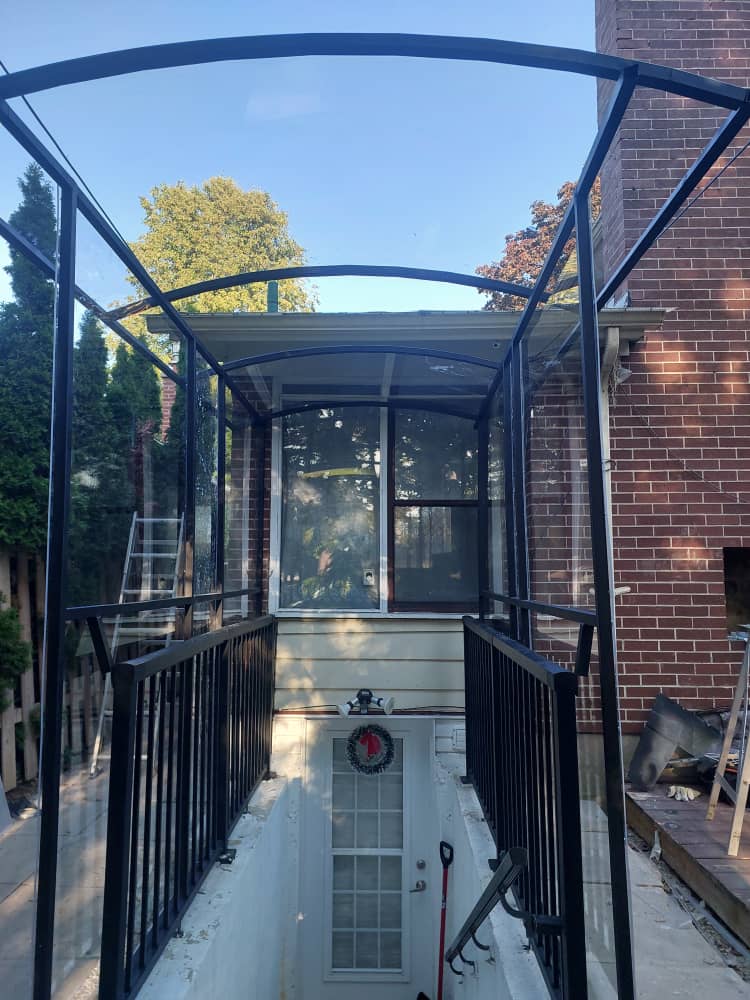
Awnings are essential elements for creating shaded areas, protecting building façades, and reducing indoor heat. When planning and installing shade structures in outdoor spaces, there are usually two common options to choose from: Canopy and Awning. Choosing the right structure ensures better performance and prevents damage to the façade and the building structure.
1. Canopy
A canopy is a type of shade structure that is installed independently from the wall and can be freestanding or suspended.
Features and Applications:
-
Common materials: durable fabrics or polycarbonate sheets for the cover, and a metal frame for structure and support.
-
Suitable for open areas such as parking spaces, entrances, and yards.
-
Capable of withstanding wind and snow loads.
-
Does not exert significant pressure on the façade, making it ideal for buildings with sensitive or stone cladding.
Main Advantage:
A canopy provides protection without direct mounting on the wall, making it safer for delicate façades and allowing for larger, stronger structural designs.
2. Awning
An awning is a shade structure that is directly mounted onto a wall or above a window, and it is generally lighter than a canopy.
Features and Applications:
-
Common materials: polycarbonate sheets for the cover, metal for the frame.
-
Suitable for windows, balconies, and small entrances.
-
Can be retractable or fixed, with manual or motorized mechanisms.
-
Requires precise installation and proper sealing washers to avoid damage to the façade.
Main Advantage:
An awning is a practical, cost-effective choice for small or limited spaces, providing quick shading. However, because it mounts directly to the wall, improper installation may cause façade damage.
3. Choosing Between Canopy and Awning
-
If your goal is to create shade in an open area while protecting the façade, a Canopy is the better choice.
-
If your space is limited and you need shade for a window or small balcony, an Awning is suitable — but professional installation is essential to prevent damage.
4. Price Comparison
-
Awnings are generally more affordable due to lighter materials and simpler structures.
-
Canopies cost more because they require stronger metal frameworks and offer higher durability.
-
Final pricing for both options depends on fabric type, dimensions, and whether the system is retractable.
Conclusion
For outdoor shade installation, you have two primary options:
-
Canopy: durable, independent, suitable for open areas and sensitive façades, higher cost
-
Awning: lightweight, retractable, ideal for windows and balconies, lower cost, requires precise installation
Your choice depends on the available space, façade type, and budget. In both cases, proper installation by a skilled professional ensures longer lifespan and protects the aesthetic appeal of your building façade.
No comment